Step-by-Step Action Trail Action Trail Technology

Open-Source & Self-Hosted Alternatives

Clean open-source and self-hosted alternatives to expensive SaaS tools.
29 Resources (Page 1 of 3) · Curated by @oss_viktor
Embed “Open-Source & Self-Hosted Alternatives” on Your Blog

Paste this lightweight snippet anywhere on your site or blog — renders cleanly via Shadow DOM without changing your layout or Storesso’s look:

0 of 10 steps completed
Step 1

Yash Nandvana — Full Stack Developer | MERN, React, Shopify

Curator’s note: Verified free tool resource on yashnandvana.in (496ms live load) added via HN Interactive Demos.

“I'm Yash Nandvana, a dedicated full-stack developer focused on building impactful digital experiences. My skills span React, Node.js, and the broader MERN stack, and I'm constantly pushing myself to grow and improve.”

Jump to Highlight ↗

DevAtlas is the definitive developer directory curating 3,300+ verified developer tools, AI coding assistants, autonomous testing agents, runtime infrastructure, and open-source GitHub repositories. Built with Next.js, React, and TailwindCSS, it provides instant client-side keyword search, deep multi-category navigation, persistent theme switching, and seamless discovery for developers seeking to build faster and ship better. I'm Yash Nandvana, a dedicated full-stack developer focused on building impactful digital


Step 2

gavel: guided code review with your coding agent

Curator’s note: Verified free tool resource on photostructure.com (197ms live load) added via HN Open-Source Tools.

“Review local Git changes in your browser with Claude Code or Codex. The gavel skill tells your agent to prepare a brief, explain its choices beside the code, and guide you through the diff.”

Jump to Highlight ↗

Howdy!I've been working on an open-source tool that helps lighten the burden of reviewing what your coding agents write. You still see all the lines of code, but the agents write a "tour guide" that links you through the local PR, and as you have questions or comments, you chat with your agent in the context of the code, in a threaded conversation.I called it "gavel" (you make your agents build a case that you judge). Hope you find it as useful as I do!https://github.com/photostructure/gavel

Step 3

Pizza | A little Pizza. A lot done.

Curator’s note: Verified free tool resource on pizza.hertzbeat.com (174ms live load) added via HN Open-Source Tools.

“Your desktop companion for code, ideas, and everyday work. Keeps the conversation going, with your apps connected.”

Jump to Highlight ↗

Hi HN, I made Pizza, an open-source, event-driven AI agent. No `while true`.Each turn is a state machine. Conversations and tool calls go into an immutable SQLite log. The UI, model context, and session tree are built from that log.The model gets one tool: a CLI. Reading files, editing code, and running commands all go through it.You can keep a conversation going without manually starting new sessions.

Step 4

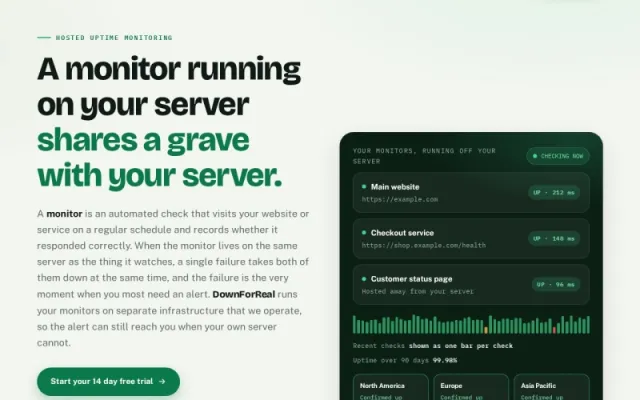
DownForReal - Hosted uptime monitoring powered by Uptime Kuma

Curator’s note: Verified free tool resource on downforreal.com (390ms live load) added via HN Open-Source Tools.

“A monitor is an automated check that visits your website or service on a regular schedule and records whether it responded correctly. When the monitor lives on the same server as the thing it watches, a single failure…”

Jump to Highlight ↗

I use Kuma for a few microservices I’ve built. It’s a simple open source tool for monitoring APIs, ports, websites etc if they are down.The issue I get is that they are hosted on your own infrastructure, so it doesn’t do you a whole lot of good if your site is down and it takes your Kuma down with it. This also leads to a bunch of false notifications which are annoying.From what I can tell, people in the GitHub comments are looking for hosted Kuma.I built DownForReal (largely with LLMs) but what it does is it…

Step 5

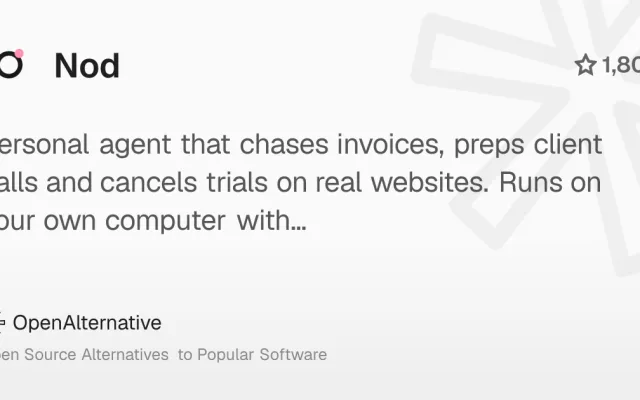
Nod: Open Source Alternative to Grok Bot, OpenAI Dots, and more

Curator’s note: Verified free tool resource on openalternative.co (487ms live load) added via OpenAlternative.

“It comes from the team behind n8n, but it's a separate app and doesn't require n8n.”

Jump to Highlight ↗

Nod is a personal agent with its own computer. It does errands on real websites and in your connected apps, and it asks before it acts for you. It's built for people who run their own work: client calls, follow-ups, invoices, supplier portals. Life admin like refunds and bookings works too. It comes from the team behind n8n, but it's a separate app and doesn't require n8n.

Step 6

Self-Host Weekly (13 November 2026)

Curator’s note: Verified free tool resource on selfh.st (202ms live load) added via Selfh.st.

“If you missed it, I posted the results of the 2026 Self-Host User Survey this week (link below). Thanks again to all who participated – in total, it received 6,221 responses (a 52% increase from last year's 4,081 🚀).”

Jump to Highlight ↗

PocketAdmin 1.4: fix your homelab from your iPhone, with an AI that asks first. See how it works · Get it on the App Store If you missed it, I posted the results of the 2026 Self-Host User Survey this week (link below). Thanks again to all who participated – in total, it received 6,221 responses (a 52% increase from last year's 4,081 🚀).

Step 7

Announcing Hegel-clj

Curator’s note: Verified free tool resource on aphyr.com (209ms live load) added via Lobste.rs Releases.

“I do a lot of generative testing in Clojure with the excellent test.check. However, using test.check can be frustrating! In particular, complex generators can get stuck during shrinking, leaving me trying to prune down…”

Jump to Highlight ↗

I’ve just released hegel-clj, a Clojure interface for the Hegel generative testing library. You can jump right to the docs, but I thought it might be interesting to explain why I want another testing library. I do a lot of generative testing in Clojure with the excellent test.check. However, using test.check can be frustrating! In particular, complex generators can get stuck during shrinking, leaving me trying to prune down a complex data structure by hand. The culprit is usually bind.

Step 8

Dyalog Version 21.0 - Dyalog

Curator’s note: Verified free tool resource on dyalog.com (816ms live load) added via Lobste.rs Releases.

“Dyalog v21.0 is supported on the following platforms/operating systems:”

Jump to Highlight ↗

Dyalog v21.0 was released in November 2026 and is supported under Microsoft Windows, IBM AIX, Linux for x64 and ARM (incl. Raspberry Pi), and Apple macOS. Dyalog v21.0 is supported on the following platforms/operating systems:

Step 9

ARTEX: How a Free AI Pentest Framework Became an Attacker Staple

Curator’s note: Verified free tool resource on blog.ostorlab.co (353ms live load) added via HN Open-Source Tools.

“That is a short runway for a security tool. By November, Microsoft had published two reports on actors using it, CrowdStrike had published two more, Seoul police had described a criminal case built on it, and…”

Jump to Highlight ↗

ARTEX matters because it automated the expensive part of penetration testing: chaining ordinary weaknesses at machine speed. Within three months of its July 2026 GitHub release it was used against South Korean banks, in a supply-chain compromise and in a 200-target espionage campaign. Wiz Research reports that a Chinese developer published it, that it won Baidu's "Agent+" red-team challenge that September, and that the project went closed-source on October 8, after attackers had already used it against South…

Step 10

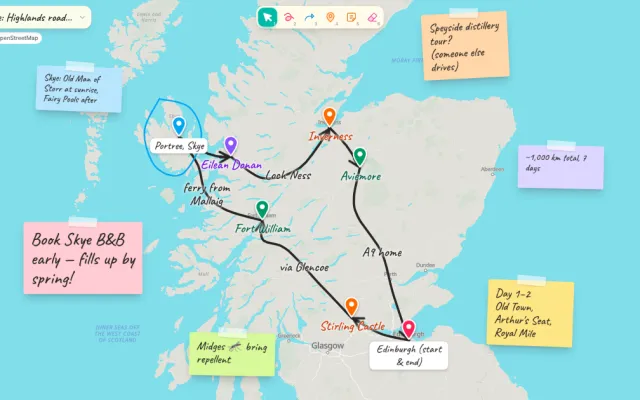
Mapboard: Plan trips on a map with routes, pins and notes

Curator’s note: Verified free tool resource on mapboard.bruceroettgers.eu (89ms live load) added via HN Open-Source Tools.

“Hi HN!I was missing a (travel) planning tool that would let me plan at any detail level and start with a rough sketch. I wanted the flexibility to just put post-its on parts that are not planned (in detail) and a more…”

Jump to Highlight ↗

Hi HN!I was missing a (travel) planning tool that would let me plan at any detail level and start with a rough sketch. I wanted the flexibility to just put post-its on parts that are not planned (in detail) and a more detailed plan for other parts.So I built a map that you can mark up with drawings, markers and post-its. Additionally you can link to different boards from markers to i.e. plan a city within a larger trip.It's built using Maplibre, with self-hosted Protomaps for the tiles and Yjs for state.